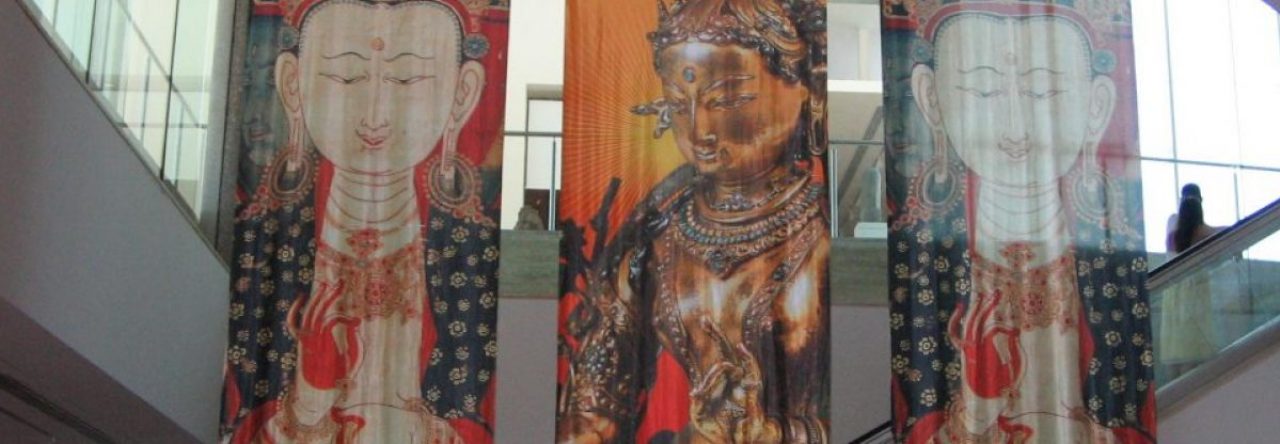
Where Buddhism Meets Gendlin

Tag: mindfulness

The Honeyball Teaching (A Fictional Telling)


The Honeyball Teaching

A Narrative Retelling of the Madhupiṇḍika Sutta (MN 18)
by Christopher Ash (Formerly Christopher McLean)

1. The Encounter in the Great Wood

One time the Fortunate One was staying in Sakyan country, near his birthplace of Kapilavatthu, in the Banyan Park. In the early morning, he went to Kapilavatthu for his almsround and to eat his meal. Afterward he went to the Great Wood for the afternoon’s abiding. Going deep into the Great Wood, he sat down at the root of a young bilva tree.

Now, the Sakyan Daṇḍapāṇi (whose name means “Stick-in-hand”) was roaming about for exercise, leaning on his stick. So it was that he also came to the Great Wood, and going deep into the wood, he came upon that bilva tree where the Fortunate One sat. On arrival he exchanged friendly greetings with the Fortunate One. When the greetings were concluded, he stood to one side, resting on his stick, and asked:

“What is the recluse’s doctrine? What does he teach?”

The Fortunate One replied: “Friend, I teach a doctrine according to which one does not quarrel with anyone in the world with its devas, Māras, and Brahmās, in this generation with its recluses and brahmins, its princes and men. It is a teaching by which perceptions no longer beset a person who abides detached from sensual pleasures, without perplexity, freed from worry, devoid of craving for existence. That is my doctrine; that is what I teach.”

When this was said, Daṇḍapāṇi shook his head, wagged his tongue, and raised his eyebrows into three wrinkles on his forehead. Then, leaning on his stick, he departed.

2. The Brief Summary at Banyan Park

When the afternoon was over, the Fortunate One rose from his day’s abiding and went back to the Banyan Park. He sat down on the prepared seat and told the bhikkhus what had taken place between himself and Daṇḍapāṇi the Sakyan.

When he had told them, a bhikkhu asked: “Sir, what is this teaching by which one does not quarrel with anyone in the world? And how is it that perceptions no longer beset a person who abides detached from sensual pleasures?”

The Fortunate One answered: “Bhikkhu, as to the source through which perceptions and categories born of mental proliferation beset a person: if nothing is found there to delight in, welcome, and hold to, this is the end of the underlying tendency to lust, the end of the underlying tendency to aversion, the end of the underlying tendency to views, the end of the underlying tendency to doubt, the end of the underlying tendency to conceit, the end of the underlying tendency to desire for existence, the end of the underlying tendency to ignorance. This is the end of taking up rods and weapons, of quarrels, disputes, accusations, divisive talk, and false speech; here these evil unwholesome states cease without remainder.”

That is what the Fortunate One said. Having said this, the Well-Farer rose from his seat and went into his dwelling.

3. Approaching Venerable Mahā-Kaccāna

Soon after the Fortunate One had left, the bhikkhus thought: “The Fortunate One has just given a brief summary and gone into his dwelling without explaining its detailed meaning. Now who can explain the detailed meaning of this brief summary?”

Then they thought: “Venerable Mahā-Kaccāna is praised by the Teacher and esteemed by his wise companions in the holy life. He is capable of expounding the detailed meaning of this summary given in brief by the Fortunate One. Suppose we were to go to Venerable Mahā-Kaccāna and ask him about the meaning of this?”

So the bhikkhus went to Venerable Mahā-Kaccāna and exchanged greetings with him. When the friendly greetings were finished, they sat down to one side and told him what had taken place, asking: “Let Venerable Mahā-Kaccāna expound the meaning to us.”

Mahā-Kaccāna smiled and said: “Friends, it is as though a man needing heartwood, seeking heartwood, wandering in search of heartwood, thought that heartwood should be sought for among the branches and leaves of a great tree, after he had passed over the root and the trunk. And so it is with you, venerable sirs, that you think I should be asked about the meaning of this, after you passed the Fortunate One by when you were face to face with the Teacher. For knowing, the Blessed One knows; seeing, he sees; he is vision, he is knowledge, he is the Dhamma, he is the holy one; he is the sayer, the proclaimer, the elucidator of meaning, the giver of the Deathless, the lord of the Dhamma, the Tathāgata. That was the time when you should have asked the Fortunate One the meaning. As he told you, so you should have remembered it.”

“Surely, friend Kaccāna, knowing, the Blessed One knows; seeing, he sees… That was the time when we should have asked the Fortunate One. Yet Venerable Mahā-Kaccāna is praised by the Teacher and appreciated by his companions in the holy life. You are capable of analyzing the detailed meaning of this teaching given in brief. Please, walk us through the meaning, friend Kaccāna!”

“In that case, friends, listen carefully. We will see what we can learn from this teaching.”

4. The Unpacking of Proliferation (Papañca)

Venerable Mahā-Kaccāna said:

“Friends, when the Fortunate One gave that brief statement: ‘As to the source through which perceptions and categories born of mental proliferation beset a person: if nothing is found there to delight in, welcome, and hold to, this is the end of the underlying tendencies…’, I understand the detailed meaning to be as follows:

Dependent on the eye and visible forms, eye-consciousness arises. The meeting of the three is contact. With contact as condition, there are feeling-tones—pleasant, unpleasant, or neutral. What one feels, one perceives. What one perceives, one thinks about. What one thinks about, one mentally proliferates. What one mentally proliferates, with that as source, perceptions and categories born of mental proliferation beset a person with respect to past, future, and present forms cognizable by the eye.

Dependent on the ear and sounds, ear-consciousness arises…
Dependent on the nose and odors, nose-consciousness arises…
Dependent on the tongue and tastes, tongue-consciousness arises…
Dependent on the body and tactile objects, body-consciousness arises…
Dependent on the mind and mental phenomena, mind-consciousness arises…

So, brothers, where there is the eye, forms, and eye-consciousness, it is possible to delineate contact. Where contact is delineated, feeling-tone is delineated. Where feeling-tone is delineated, perception is delineated. Where perception is delineated, thinking is delineated. Where thinking is delineated, being beset by categories born of mental proliferation is delineated.

Conversely: where there is no eye, no forms, and no eye-consciousness, it is impossible to delineate contact. Where there is no contact, feeling-tone cannot be delineated. Where there is no feeling-tone, perception cannot be delineated. Where there is no perception, thinking cannot be delineated. Where there is no thinking, being beset by the complications of mental proliferation is impossible. And so it is for all the six sense channels.

All the conflict in the world has its origin in the misperception of how things are—the misperception that objects of the six sense channels exist as solid, independent entities on their own side. If nothing is found there to delight in, welcome, and hold to, the entire structure of proliferation collapses.

Now, if you wish, check this with the Fortunate One. However the Eye of the World answers, that is how you must remember it, so that you can test it in practice.”

5. The Sweetness of the Honeyball

The group was grateful to Mahā-Kaccāna for his clear, inspiring exposition. They thanked him and returned to the Fortunate One.

They found him, bowed, sat to one side, and reported how Venerable Mahā-Kaccāna had expounded the detailed meaning of the teaching-in-brief.

The Fortunate One heard them out and said: “Mahā-Kaccāna is wise, bhikkhus, a person of considerable discernment. If you had asked me about this, I would have explained it to you as he did. That is the meaning of this statement, and so you should remember it.”

Ānanda, who had been listening, said: “Sir, it is just as if a person who was stricken with hunger and weak with thirst were to come across a honeyball, wherever he tasted it he would experience its sweet, delectable flavor. So too, any able-minded bhikkhu, wherever he scrutinizes the meaning of this discourse with wisdom, will find satisfaction and confidence of mind. What shall we call this teaching?”

The Fortunate One replied: “Ānanda, you may remember this teaching as ‘The Honeyball Teaching.’”

Ānanda delighted in that suggestion, and so it has been.


Being Oneself Dear

Self-Love as Living Care in the Early Suttas

The early Buddhist suttas offer an approach to self-love. They treat it not as a fault to be hidden, not as an ego being inflated – as in everyday narcissism – but as a living fact of sentient experience. It’s a basis from which safety, ethics and spiritual growth can flourish. The fact of self-love is simple to articulate, yet it is subtle if you want to experience it healthily, and its reach is wide. To use a modern idiom, this approach is grounded in the fact that our bodies have an innate ‘optimising dynamic.’ If this is not suppressed or indulged, a human body feels its ‘life-forward implying.’

Self-love, in this view, does not primarily mean over-thinking well of oneself. As I said, that’s the everyday version of narcissism. But healthy self-love arises from, and refers back to, the felt sense each of us has that our own life matters to us, and that there is a natural imperative to take care of oneself and others. In holding ourselves dear, we are not making an error to be corrected, but touching something basic in being alive. And when this is understood rightly, self-love participates in – carries forward – our care for others.

The Pāli texts do not use a single term for what we now call “self-love.” They speak of holding oneself dear (attā piyo), of one who loves himself (attakāma), of one’s own welfare (attattha), of being self-protected (attarakkhita), and of the self as its own protector (attā hi attano nātho). These expressions don’t point to a fixed concept but they direct us to a range of ways of caring for one’s own heart-mind, the citta.

What follows draws these threads together. It is offered not as a doctrinal summary but as an invitation to sense how, in the Buddha’s orientation, self-love becomes a practice rather than a mere conceit.

Queen Mallikā on the Palace Terrace

The starting point is an intimate exchange between Queen Mallikā and King Pasenadi of Kosala, recorded in the Mallikā Sutta (SN 3.8) and also in the Udāna (Ud 5.1). Relaxing together on the upper terrace of the palace, the king asks his favourite queen whether there is anyone dearer to her than herself. Mallikā’s answer is straight-forward: “There is no one, great king, dearer to me than myself.” And she turns the question back to him. Pasenadi, after a moment, admits the same is true for him.

Soon afterward, the king brings this interchange to the Buddha (perhaps he was unsure of its wisdom) but the Buddha does not correct him. He instead confirms Mallikā’s insight and speaks a verse (a common practice at the time, it seems):

“Having traversed all quarters with the mind, one finds none anywhere dearer than oneself. Likewise, each person holds himself most dear; hence one who loves himself should not harm others.”

Notice the movement here. Mallikā’s answer could be heard as a confession of everyday narcissism, but the Buddha hears something else: an honest report of how life actually feels from within. And from her statement, he points to an ethic – a ground for caring for others.

Self-Love Is Not Vanity

In a popular moralistic view, love of self is suspect – something to be suppressed so that love of others may take its place. The suttas don’t support this opposition. For the Buddha, authentically holding oneself dear is not a moral failing but an existential baseline, the living ground of any sentient life. To deny it would be to attempt to establish the path on a dogma. The issue, here, is not whether we love ourselves, but how. The Buddha repeatedly leverages this deep psychological fact to establish ethics, mental protection and spiritual development. Self-love, rightly understood, is not a closed ego-bubble (alāya). It is the very place from which the heart opens.

Taking Oneself as the Measure

The first opening is ethical. Each being cherishes its own well-being, so recognising my own longing for happiness lets me feel the same longing in others. This is not an inference from premises so much as a bodily recognition: if I directly sense how my own life carries itself forward – wanting to live, flinching from pain, impacted by the selfishness of others, and so on – from this my body knows that others are like me. The foundation of this is that bodies are resonant with everything else, in a felt interdependence.

The Dhammapada gives this its classic form (Dhp 129–130): all tremble at the rod, all fear death, all hold life dear; taking oneself as the comparison (attānaṃ upamaṃ katvā), one should neither kill nor cause others to kill. The Buddha is reported in the Nālaka Sutta (Sn 3.11) as suggesting we should live this way: “’As I am, so are these. As are these, so am I.’ Drawing the likeness to yourself, neither kill nor incite others to kill.”

Here self-love becomes the measuring rod of non-harm (ahiṃsā). The more truly I feel my own life from within, the less possible it becomes to treat another life as a mere object. The practice of mindfulness with situational awareness bears this out.

Friend or Foe to Oneself

In the discourse just before Mallikā’s, the Piya Sutta (SN 3.4), King Pasenadi is puzzled. Observing the behaviour of those around him, he asks who really holds themselves dear, and who treats themselves as a foe? People acting in a selfish way which leads to their trouble aren’t caring for themselves.

He takes his answer to the Buddha, and the Buddha endorses it. Those who engage in misconduct of body, speech and mind may well say, “We love ourselves.” Yet they act toward themselves exactly as an enemy would act toward an enemy – planting the seeds of their own future suffering. (Isn’t this, nowadays, so evident from the daily news?) Those who live wholesomely in body, speech and mind may never say they love themselves, yet they are treating themselves as a dear friend treats a friend, thereby securing their present peace and their future welfare (attattha).

So true self-love is not a feeling one clings to for aggrandisement. It is measured by what one’s actions do to carry one’s own life forward harmoniously, evidenced by our heart-mind’s (citta’s) pliancy. Living this way, one can then find peace with one’s mind. Self-love, here, is less a sentiment than a way of carrying oneself forward spiritually.

Protection From Within

In the another discourse, the Attarakkhita Sutta (SN 3.5), Pasenadi notices that people habitually seek safety outwardly – in troops of elephants, cavalry, chariots, fortresses and wealth. (Nowadays, it’s SUVs and huge square houses that look like fortresses.) The Buddha confirms that such protection is fragile and incomplete. Real protection is internal: built from ethical conduct (sīla), restraint of the senses (indriya-saṃvara) and the cultivation of the mind (bhāvanā). One who is virtuous in ‘body, speech and mind’ is guarded, even with no army at all.

How can this work? I haven’t room to go into this in detail right here; however, suffice it to say that through self-care one realises a level of unified body-environment interaction which is not established on such distinctions as inner-outer, me-others, good-bad.  Says a Sufi poet, Rumi: “Out beyond ideas of wrongdoing and rightdoing/There is a field. I’ll meet you there.” Furthermore, this is not only a citadel to be experienced in this life but remains so in the dying process.

The general approach regarding self-care finds a memorable expression in the Sedaka Sutta (SN 47.19). Two acrobats prepare to perform on a bamboo pole. Before their balancing performance the boss proposes to the young female assistant, Medakathalika, “You look after me, and I’ll look after you.” She corrects him: “That won’t do, Sir. You look after yourself, and I’ll look after myself. This way, self-guarded and self-protected, we’ll perform our feats and come down safely.”

This is subsequently reported to the Buddha, who approves Medakathalika’s point and draws the lesson for mindfulness: protecting oneself, one protects others; protecting others, one protects oneself. These are not two separate projects that happen to coincide. Inner balance and care for others co-arise in one event. A practitioner steadied by satipaṭṭhāna does not neglect others, but watches out for their welfare. In fact, in the Metta Sutta kindness is itself a mindfulness practice.

The Citta is What We Care For

When the suttas speak of “self” (attā) in a positive, practical sense: “Self is the protector of self,” says Dhammapada (verse 160); “for what other protector could there be? With oneself well tamed, one gains a protector hard to find.” Here, the word attā is functionally close to citta (the heart-mind), the felt centre of one’s experiencing. To care for oneself is, above all, to care for this. In the opening chapter of the Aṅguttara Nikāya (AN 1, around suttas 31–40), the Buddha declares that he sees no other single thing which, unguarded, leads to such great harm as the citta (heart-mind) – and none which, guarded, leads to such great good.

Being One’s Own Authority

In the teaching on the three authorities (adhipateyya, AN 3.40), the Buddha speaks of taking oneself as one’s authority (attādhipateyya). This is possible with uncontrived, mindful experience, accompanied by situational awareness. One who lives thus acts from deep self-respect and moral conscience (hiri). True conscience isn’t in import from without. It’s not the superego’s version of things. It’s from a deeper place of non-comparison. The mindful person knows whether what one does is true or false – she feels the ‘fit’ with life from within.

This is self-love as integrity. It is not pride, but a refusal to betray one’s own knowing. A person who honours this ‘inner sense’ turns away from unwholesome action – not from fear of others, but because they will not dim their own awareness.

Where Mettā Begins

Many people today learn loving-kindness (mettā) as a sequence that begins with oneself: “May I be happy, may I be free from suffering, may I live in peace,” then moving outward to friends, neutral persons, difficult persons and finally all beings. This is good. Seen in the light of the suttas above, starting with having metta for oneself is not a selfish move. It is an emotional anchor. A genuine, unreserved experience of well-wishing toward one’s own life becomes a boundless clarity, which can then be extended outward without obstruction – not as a rule applied, but as a felt sense carried forward into ever-wider situations – above, below and all across.

(The ‘five persons’ sequence, beginning with oneself, comes from the commentator Buddhaghosa, writing many centuries after the Buddha.[i])

The Community That Cares for Itself

The Buddha extends this principle from the individual to the collective. In the Mahāparinibbāna Sutta (DN 16), King Ajātasattu plans to attack the Vajjian republic and sends his minister to ask the Buddha’s view. The Buddha replies indirectly, naming seven conditions for non-decline (aparihāniyā dhammā). He says that as long as the Vajjis meet often and in harmony, honour their established customs, respect their elders, protect their women, and maintain their shrines and support those who live the holy life, they can be expected to prosper, not decline.

Communal self-care, then, is the macrocosm of personal self-care. A people protects itself not through aggressive power but through inner harmony, ethical restraint and mutual respect. The Buddha immediately applies the same conditions to the monastic Saṅgha. Whether as a person or as a community, one secures one’s future welfare by guarding one’s inner integrity. After all, I say, a community is only as good as the quality of care shown by its individual members.

Implications for Practice

The suttas’ treatment of self-love offers a corrective in two directions. Against the culture of self-indulgence, it shows that much of what passes for loving oneself is, on examination, treating oneself as an enemy. On the other hand, against a certain kind of ‘spiritual’ superego-ish severity, it shows that the path does not ask us to deny that our own life is dear to us. It asks us to sense our value more fully and with greater clarity, and to let it change us. Remember that it was by nourishing the living organism (kāya) just enough to support deep concentration rather than torturing it, that the Buddha discovered the Middle Way and achieved liberation under the Bodhi tree. (Mahāsaccaka Sutta (MN 36)

In practice this means pausing and attending inwardly: how is my heart-mind right now? What would truly be for its welfare? Such questions are not answered by formula. They are answered by an attention that stays with one’s bodily life-forward implying, with what is felt, and lets the next wholesome step come from there.

Conclusion: Self-Love as Living Process

In the early suttas, self-love is not a fixed attitude but a living process – a way of caring for one’s own heart-mind that, followed honestly, opens into care for all beings. Buddhism is basically taking care of self and others. It begins in the plain truth Mallikā spoke on the palace terrace, and it moves outward through non-harm, inner protection, mindful attention, integrity, loving-kindness and communal harmony. Here, holding oneself dear is not the opposite of holding others dear. It is where the holding begins. Protecting oneself, one protects others; protecting others, one protects oneself.

oOo

I welcome any feedback: christopher at wholebodymindfulness dot com.


[i]The Buddha did not teach the now-common practice of beginning mettā with oneself and moving through a sequence of persons. That sequence comes from Buddhaghosa, in Chapter IX of the Visuddhimagga. In the suttas, the Buddha teaches mettā as a directional practice – pervading above, below, across and everywhere, the whole world (loka) of one’s experience. Buddhaghosa’s version, however, is not contrary to the spirit of the Buddha’s instructions. You can find online.

Letter to Kalyanamitta

An Open Letter on Purposelessness

13 Oct 2026

Dear Friends,

I want to write to you about something that comes up again and again in our practice, sometimes as a hope and sometimes as a fear: purposelessness. Buddhism calls it aimlessness or wishlessness (appaṇihita). In Chan and Zen it is called nonseeking (wuqiu). In Taoism it’s the effortlessness of wei-wu-wei. To the Christian mystic Meister Eckhart it was: ‘living without a why.’

Let me begin by clearing up a common misunderstanding, though. True purposelessness is not nihilistic collapse, apathy or depression. It’s a responsiveness, an open, engaged abiding here and now.

A.H. Almaas points out that mistaking spiritual ‘purposelessness’ for meaninglessness or haphazard passivity is an error. It is a state of disconnection, not realisation:
“One cannot say that there is no such thing as purpose and motivation, and that it is therefore fine to live a haphazard and meaningless life. That attitude would abrogate one’s human nature, for as long as one still lives in the cognitive sphere one’s life requires purpose and meaning… Only when we have integrated the nonconceptual can we say we do not need meaning, purpose, or motive. Otherwise, we will be stuck in the meaninglessness and purposelessness that are the opposite of meaning and purpose.” – Inner Journey Home

True purposelessness is not absence of vitality; it is what remains when egoic striving ceases. It’s grounded in a dimension that is deeper than perception or thought.

Put simply, it is the freedom that arrives when you stop treating the present moment as a stepping stone to somewhere else. Here are four practical insights which can help you meet this in daily life and in practice.

1. Practise what you do as an instance of now

In ordinary life, and often in spiritual life too, we fall into what Chögyam Trungpa named as ‘spiritual materialism’ – doing our spiritual practice get something. We meditate to become calm. We work on ourselves to become a “better” person. We do mindfulness to help us be a success. (I’ve heard that called ‘neoliberal spirituality’.) If you spot a version of that in yourself, don’t judge it. Being hard on yourself is more of the same. Simple let it go. Everything does move on. An Tibetan acquaintance once suggested the example of someone up on the stage in the movie theatre with his cans of paint, trying to capture the moving picture.

There’s a lovely story in the Devasamyutta about the Buddha meditating in the forest and a deva named Kakudha approaches him and says, “Are you happy?” The Buddha answers “On gaining what, Friend?” The deva reframes and says, “Are you unhappy?” The Buddha says, “What has been lost, Friend?” This is appaṇihita. (It also suggests that there are no things to gain or lose; it’s all change.) When you sit, you sit simply because you are already-always present – not to manufacture a special state. Of course, relax. Let go of stressing, just because gaining mind is stressful. Put the burden down.

Thich Nhat Hanh offers a apt image for this: “Does a rose have to do something? No, the purpose of a rose is to be a rose. Your purpose is to be yourself.” (The Heart of the Buddha’s Teachings) When you stop chasing an ideal self – indeed, chasing being any kind of self – striving comes to a peaceful halt, and you can rest in the sufficiency already present.

2. Disarm the watcher and drop the internal struggle

The ego, misconceiving itself, is forever trying to manage experience and secure feedback that it’s okay – that it’s in charge, real, and existent as an ultimate. It fights against what is. Much of our tiredness comes from this barely noticeable, but constant effort. Of course, you do notice it, but rarely notice as that kind of effort. You say it’s bad meditation, or some kind of problem. Drop the habitual commentary on how you’re getting it wrong.

Working with purposelessness means practising non-striving: letting the mind be open and uncalculated, without trying to subdue or control its energy. Krishnamurti and David Bohm (in The Ending of Time) observed that a mind freed from a fixed aim is not dull or dormant. It becomes more alive, because a larger intelligence can finally move without the ego getting in the way.

3. Need or want? Should or could?

A common fear is that without purpose we will become passive and stop caring. Yet, as both Christopher Gowans (Philosophy of the Buddha) and Sue Hamilton (I of the Beholder) note, the Buddha taught actively for some 45 years after his awakening. He acted constantly, but without binding cravings or selfish motive. We can drop investing hope for outcomes and just do what we do assured that the body-environment interaction carries us and our situations forward. The whole moves with this interactive body’s changes, which will signal the health of the move. Remember, in this context, to live without a ‘why’ is still living.

We could ask two simple questions to bring non-seeking into view:

What do I need, and what do I want? Needs keep body and community healthy. But, what you experience as a ‘need’ might be manufactured, too. Do I really need this (new device, or whatever)?
Wants can be healthy also, but they often tend to emerge from a sense of lack. ‘Want’ actually can mean ‘lack.’ So, we can ask, “What kind of lack is it?” How will we tell the difference between healthy and unhealthy wants and needs? A wanting might indicate your true need. If you want or feel you need something, check with your body’s sense of implying of its next step. Listen to the roots of your wanting, which are always situational. Situational awareness is an aspect of right mindfulness.

What should I do, and what could I do? Attend to what the situation in front of you actually asks for, rather than to endless projects that feed your self-image. Be careful of ‘should.’ Egoic functioning can be addicted to rules. “Should” might mean what other people say you need or want. On the other hand, “should” might mean “Ah! This is a good fit with the whole situation” – a real possibility. The bodily feel of the wanting without comparing it to, or defining it by, anything else is essential to discern the difference.

    [Note that if you do take time out to investigate your process, this too has to have a spirit of non-attainment. Focusing is best for this, because it requires an openness to what the body can tell you. (Focusing is yonisomanasikāra: attention in accordance with the ground.) This will ensure you don’t go off into unhelpful ruminations. Zig-zag between your questions and the fundamental space of experience-as-such.
    Also a quick note on ‘self-image.’ Firstly, because you are a flow of interaction, no image can get you. You aren’t your content, so be wary of self-image’s use. When you stop steering by your self-image and listen to what your body knows of the whole situation, you act well without forcing it. That’s what the tradition calls skilful means. (upāya).]

    4. Come home to the body

    Marion Milner at the beginning of the last century did a great exploration of purpose. “It struck me as odd that it had taken me so long to reach a feeling of sureness that there was something in me that would get on with the job of living without my continual tampering. I suppose I did not really reach it until I had discovered how to sink down beneath the level of chattering thoughts and simply feel what it meant to be alive.” – A Life of One’s Own

    When you set down your top-down agendas, you do not fall into chaos. You land in the living body. Eugene Gendlin’s Focusing work shows how this can unfold. When we stop forcing a situation to fit our plans, we can turn towards the murky, bodily felt sense of the whole of it. Hold that felt sense with spacious, non-judgemental attention, without demanding a result. Given room, the body’s own intelligence answers, offering fresh and unexpected steps that carry life forward. We can flow with what he calls ‘eveving’ – everything in everything (A Process Model).

    In short

    If I could leave you with just a few reminders, they would be these:

    • Cease treating your life as a project to be completed.
    • Act in the joy and necessity of the action itself, not for accumulation or future reward.
    • Rest in the moment as it is felt, trusting that when personal striving falls away, clarity and responsiveness are present of their own accord.
    • And, lastly: “Let the soft animal of your body love what it loves.” (from Wild Geese by Mary Oliver.
    • And…

    None of this needs to be achieved. It only needs to be noticed, again and again, with kindness.

    Warmly,
    Christopher

    October, 2026

    Animality

    “Of animality, gentleness keeps the secret. A fundamental and paradoxical wildness, as foreign to any kind of taming as childhood. Not falling only under the human condition, it delineates its limits. So close to animality that it sometimes merges with it, gentleness is experienced to the point of making possible the hypothesis of an instinct that it would call its own. It would be the trait of a primal “gentleness drive” of protection, of compassion — even of goodness itself. An instinct closest to the being that would be devoted not only to self-preservation but also relationships. What the animal disarms in advance, even in its cruelty (outside the range of human barbarity), is our duplicity.”

    – Anne Dufourmantelle. Power of Gentleness. Fordham University Press.

    I support a model of living which can (in a sense) ‘rewild’ us; not in the sense of returning to the land, the commune, or whatever (I’ll leave that to your preferences); but, I mean this in the sense of demonstrating that we are of the biosphere, already of the wild, and that ‘mind’ is already-always part of that bigger order. We have strayed from our ancestral domain, and find ourselves living very much on the surface of life. Our pervasive individual and collective disharmony is because we are not in alignment with this primordial depth. The wild order has never left us, even though we have packaged it in our conceptual units – and have come to believe that the universe really is comprised of bits. We can reclaim reality.

    So, now I’d like to turn my attention toward the core issue of identity. How does a sense of self work, and how does language affect that? And how do we turn toward the ‘primordial ground’ of Being, and reclaim good mental and planetary health? And, then, most crucially, how can we understand ‘mind’ in such a way that we enter into that depth of living which we need? I want next to show the experiential basis of the notions of self and identity; and, to suggest how such notions, when seen without duplicity, don’t contradict the central Buddhist teaching of ‘not-self.’ This will lay a foundation for our further topics, such as selfishness (everyday narcissism), and human destructiveness.

    To explore these questions, I am placing ‘experiencing’ at the centre of the way forward – just as Eugene T. Gendlin did, and just as the Buddha did. I lean in this direction as a result of my own changes. When I was in my mid-twenties – lost, and frightened of going mad – one night, a line from Bob Dylan’s Ballad of a Thin Man reached me. Dylan sang: “You know something is happening, but you don’t know what it is. Do you, Mr. Jones?” At that moment the realisation dawned, with great relief, that I was experiencing – full stop. And that we are all experiencing, and experiencing just ‘This.’ While it didn’t radically change the fact that I was having trouble accepting the ultimate, what I could recognise was that my experiencing was actual, and that it was intrinsically of something bigger. I had the sense that I belonged to an open nonconceptual dimension which was more real than my concepts about it! There was, I felt, a way forward!

    It might seem like a small thing, but it carried me forward because, experiencing being actual, I had an ever-present ground where I could focus my learning of how to live; and beyond that, where I could continue my inquiry into the nature of ‘mind.’ I didn’t understand the whole matter, right there – true – but I knew that it was true that I was happening and I could start to learn from my own living. I didn’t have to find someone who knew more than me. Where I lived and in those times, meditation teachers were as scarce as hen’s teeth. Nevertheless, I had something I could trust – the fact that something is going on, and that my experiencing is of that. I saw that could learn “from, with, in” this very body, because it was itself of nature. I realised that the body was not a pattern, but an openness to more.

    It’s worth noting a principle here, which was explicated by a Chinese Chan master of the Tang dynasty, Dongshan Liangjie (hereafter simply referred to as Dongshan). On his waking up from the ego-bubble which entrances us all, he is reported to have said: “Just don’t seek from others, or you’ll be far estranged from self. I now go on alone; everywhere I meet it. It now is me; I now am not it. One must understand in this way to merge with suchness.” – Translated by Cleary, Book of Serenity.

    As confused as I was, that night, a first recognition of “It now is me; I now am not it” had occurred. While I’ll continue to reiterate that thinking divides the Undivided, even so, that’s not the whole story. To grasp our situation of animality in a healthy way depends on a just such a recognition as Dongshan’s.

    oOo

    Letter to Friends: Concern

    Dear Kalyanamitta,

    I have had two life-long preoccupations. Firstly, ever since I was a child, I wanted to know what people were talking about when they referred to ‘the mind.’ This preoccupation first manifested as a wish to know what was meant by the word ‘I.’ At age four, I asked my father “Who am I?” I didn’t want to know my name and place in the family; but his answer was: “What are you talking about? You’re Christopher. You’re your mother’s son.” Yet, my question was more essential than this.

    I wanted to know what the nature of the knower was. I knew that I knew things, but I couldn’t see that knower, the one who was experiencing the ‘seens’ and ‘heards’ of the world. I remember later, at nine years old, staring at some stones and asking, “They’re there (those stones), so where is the one who is seeing them, the one I am in here?” I’d look back, inwardly, to see if I could discern ‘me’; but to no avail. In adult language, I can say that from age four onwards, I was occasionally beset by perceptions about (what a sophisticated person might call) ‘the inside/outside distinction.’

    I didn’t get any help in that project from my parents, or from the other the adults in my childhood world. They, as it turned out, were as lost as I was – and it showed. Violence was a constant in my childhood. It was in my home, in the local streets, and even in the classrooms at school. The human world was a very unsafe place. By the time I left high school at seventeen, I entertained the possibility that violence went with being human. The Vietnam War – a war I refused to participate in – was raging at the time. And, as well, by the completion of my university education, I knew well of two other shocking battle-fronts: one maintained by men against women, and the other maintained by men (mostly men) against the natural environs – against the earth, plants, sky, and waters; and against the non-human creatures which inhabit these domains.

    I was, of course, like everyone else, divided against myself. Regarding my own divided mind, while I was still at high school I began to take steps to find some peace. I learned a form of Eastern meditation, I encountered the philosophy of Plato and his mentor Socrates, and I also read some texts by the Christian mystic Master Eckhart. Daily meditation opened up a whole new domain of discovery, an ancestral domain. Hence, by the time I left university at twenty-three, I had started on a path of personal transformation which would resolve – for myself, at least – those two issues; that of self-knowledge, and that of the world-wide war on nature. It was clear to me that humans are lost in concepts, leading us to be insensitive to what holds us, the ever-present matrix of dynamic self-generating life.

    As I proceeded through my twenties, it became evident that our war on nature – that is, against the Earth, against women, against each other, and, peculiarly, against ourselves – all this, had its roots in our lack of direct acquaintance with (what we call) ‘mind’ and its false separation from ‘body.’ In other words, the root of all conflict lies in our estrangement from our own nature. Back in those days, too, I remember reading Gregory Bateson’s teaching that the ‘mind’ is nature, and that it is a relational process.

    As an aside, it struck me in my mid-twenties that I had been in my country’s education system for at least twenty years – from kindergarten, and on through university; and, in that time, not one of my educators had raised the issue of the meaning of the word ‘mind.’ Everyone used it in the most casual of conversations, yet no-one whom I met seriously questioned whether we knew its referent (except my fellow counter-cultural, consciousness trippers). I do know now, of course, that there were philosophers and psychologists who had long asked how we know the world, but I didn’t personally encounter them in all my years in the education system. That, I think, is an indication of the ignorance inherent in a Western education.

    Eventually, I was able to have first-hand experience of the presence of mind – firstly through Buddhist meditation practice; and then later with the help of Western phenomenology. These two streams of inquiry enabled me, not only to feel that presence but, to further specify in modern terms what kind of accessible bodily process we refer to, when saying and thinking the word ‘mind.’ The result has been the felt inclusion of the non-conceptual dimension of ‘mind,’ a palpable embrace which helped me begin to transform the causes of conflict in myself. My ‘letters’ will explicate what I mean by ‘non-conceptual.’

    The activist Buddhist monk Thich Nhat Hanh, said in Being Peace (Parallax Press): “Meditation is to see deeply into things, to see how we can change, how we can transform our situation. To transform our situation is also to transform our minds. To transform our minds is also to transform our situation, because the situation is mind, and mind is situation. Awakening is important. The nature of the bombs, the nature of injustice, the nature of the weapons, and the nature of our own being are the same. This is the real meaning of engaged Buddhism.”

    ‘Nature’ as the human and the ‘nature’ of everything else – it’s the same nature.

    So, I am writing for those interested in contributing to the solution – the ending of conflict in humans. I meet regularly with people who are interested in healing the ‘inner’ roots of human conflict, the divided ‘mind.’ I’m not dismissing the ‘outer’ which you can study in politics, anthropology, sociology, psychology (which is mostly about brains, now), nor any other sciences. Neither am I saying that we can just meditate and all problems will be solved. Action to bring about change is important. However, without getting the ‘inner’ dimension right, we’ll only be angry, hateful forces; merely hoping that our scatter-gun can bring about change. As Dylan said, we’ll become our enemy in the instant that we speak.

    sFundamentally, we need new models of the human which can stand alongside the dominant scientific concepts. Western society is still privileging models of human behaviour based on observations of the ‘outer,’ as though what’s going on ‘over there,’ at a distance, can tell us what is most essential about ourselves.

    Science hasn’t yet formed a model for human knowing which includes the way we actually experience ourselves. Science has no place for what it’s like to feel like a human. Philosopher Thomas Nagel famously asked, ‘What’s it like to be a bat?’ I presume that what he was getting at is the perennial importance of asking: ‘What’s it like to be a human being – a human being?’ “What’s it like to be you – a unique human, being?” Science is delightful and useful, to be sure, but experiencing yourself is a wholly different matter. I don’t experience neuronal networks. I experience body, feelings, perceptions, intentionality, and consciousness. (Here, there are other words and models for how to say what we experience. But this will do for now. The point is, these I can be mindful of.)

    I have had various trainings, both Eastern (Buddhism) and Western (psychotherapy and phenomenology). I have learned much about ‘this being human’ from four main sources: from my compassionate teachers; from exploring in mindful psychotherapy sessions with many non-Buddhist clients (as a therapist myself); from experiencing my own being-as-such; and, from teaching Buddhist practice. My ‘letters’ will, no doubt, reflect all that.

    I wish to suggest a model of the human being which can help transform of our underlying tendencies to destructiveness. In sum, I could say that I will unpack Nhat Hanh’s statement: “To transform our minds is also to transform our situation, because the situation is mind, and mind is situation.” (My emphasis.)

    In this model, where “Awakening is important,” I place ‘experiencing’ to the forefront. The question “What’s it like, really, to be a human?” matters in every situation on our little blue planet – the only world that we people and all the other species inhabit. Let’s talk about the state of Being-here, everywhere we can.

    Next: The person who wishes to discover what is true, what is real – and what is truly beautiful – must have a different relationship to authority than the person who ignores his or her relationship to (‘what is’).

    Powered by WordPress & Theme by Anders Norén